Mastering Subset Sums: Generating All Possible Combinations using Recursion
In technical interviews, you will frequently encounter two types of problems: Decision Problems (where you answer "Yes" or "No") and Generation Problems (where you must find or list all possible outcomes).
The problem from your screenshot is a classic Generation Problem known as Subset Sums I. Instead of checking if a single target sum is possible, your goal here is to calculate the sum of every single possible subset, store them in a list, and return them in sorted order.
This guide will break down this foundational recursion problem step-by-step, building the mental model you need to ace it in an interview.
1. Understanding the Problem
Problem Statement
Given an array of N integers, find the sum of all possible subsets of the array. Return these sums in a single vector/list sorted in increasing order.
Example
- Input:
arr = [2, 3] - Output:
[0, 2, 3, 5] - Explanation: The subsets of
[2, 3] are:Sorting [0, 2, 3, 5] gives us our final answer: [0, 2, 3, 5].- Empty subset
[] → Sum = 0 - Subset
[2] → Sum = 2 - Subset
[3] → Sum = 3 - Subset
[2, 3] → Sum = 2 + 3 = 5
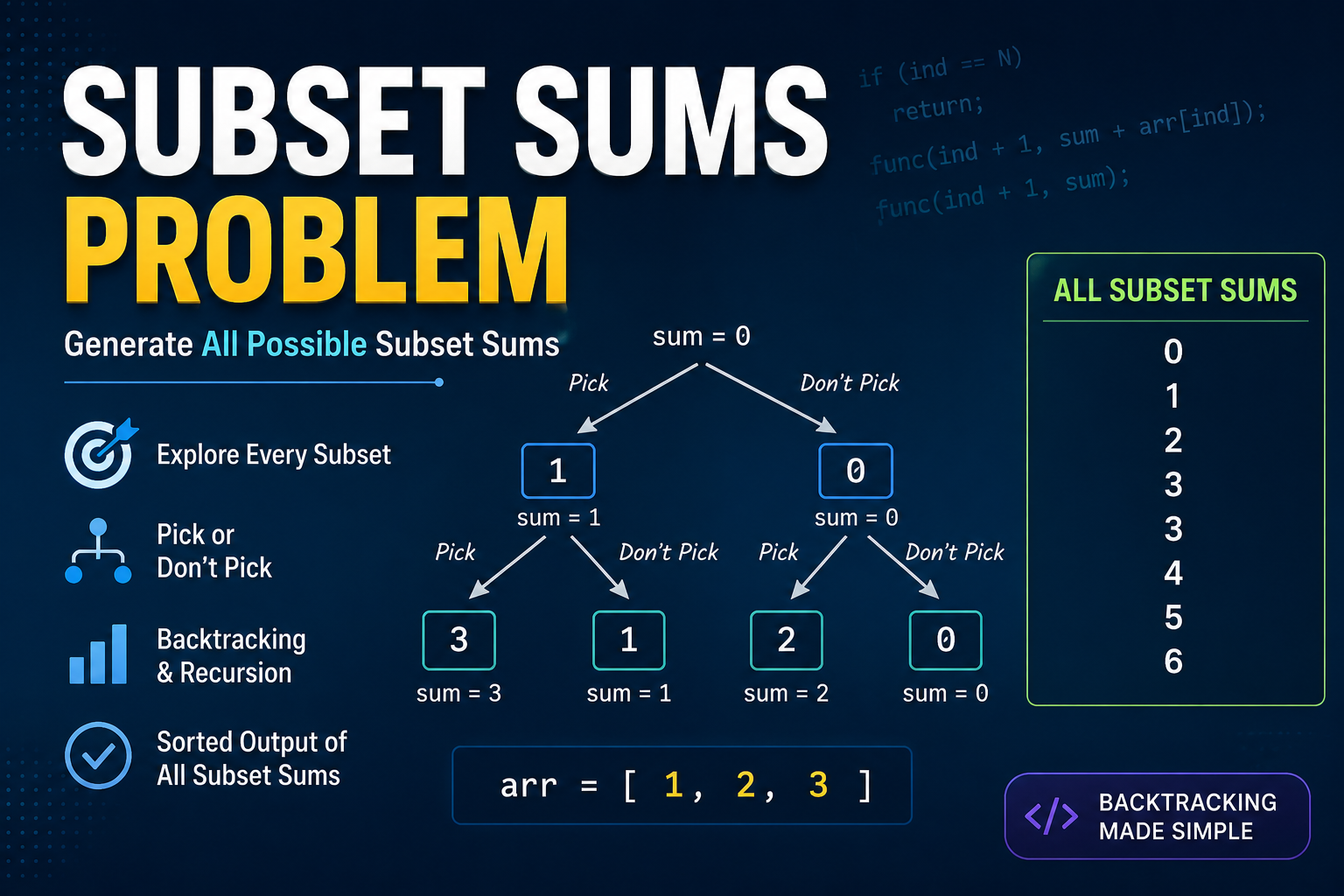
2. The Intuition: The "Pick vs. Skip" Binary Tree
For any subset generation problem, the core strategy relies on a simple rule: Every element in the array has the right to be included or excluded.
Imagine walking down a path with the array [2, 3]. You encounter the number 2. You have two choices:
- Pick
2: Add 2 to your current running sum and move to the next number. - Skip
2: Keep your running sum exactly as it is and move to the next number.
Because every single element offers exactly 2 choices, an array of size N will branch out into exactly 2N unique leaf nodes. Each leaf node represents a completely unique subset.
Why can't we use Dynamic Programming (DP) here?
In the decision version of this problem, we use DP to skip over duplicate states to save time. However, because this problem requires us to collect every single individual subset sum, we cannot skip anything. We absolutely must visit all 2N combinations. Therefore, pure recursion/backtracking is the optimal approach here.
3. Designing the Recursive Structure
To turn this intuition into working code, our recursive function needs a clear state and a definitive stopping point.
The Recursive State
Our function needs to track four things:
ind: The index of the element we are currently evaluating.sum: The running sum accumulated so far by our choices.arr: The original input array.sumSubset: A container (passed by reference) to store the final sum whenever we successfully finish processing a subset.
The Base Case
When do we know a subset is fully formed? When our index ind reaches the end of the array (ind == N).
At this exact moment, our running sum is complete. We push it into our sumSubset vector and return to backtrack and explore other choices.
if (ind == N) {
    sumSubset.push_back(sum);
    return;
}
4. Complete Step-by-Step Dry Run
Let's trace exactly how the code executes for arr = [2, 3] with N=2. We start our call at func(0, 0) meaning ind = 0, sum = 0.
func(0, 0)
                          /          \
               PICK arr[0]            SKIP arr[0]
               (Add 2 to sum)         (Sum stays 0)
                    /                      \
             func(1, 2)                     func(1, 0)
             /        \                     /        \
       PICK arr[1]   SKIP arr[1]      PICK arr[1]   SKIP arr[1]
      (Add 3)        (Skip 3)        (Add 3)        (Skip 3)
         /              \               /              \
     func(2, 5)     func(2, 2)      func(2, 3)     func(2, 0)
     [Base Case]    [Base Case]     [Base Case]    [Base Case]
    Pushes: 5       Pushes: 2       Pushes: 3       Pushes: 0
func(0,0) calls Pick branch: ind becomes 1, sum becomes 0 + 2 = 2.func(1,2) calls Pick branch: ind becomes 2, sum becomes 2 + 3 = 5.func(2,5) hits Base Case (ind == 2). 5 is pushed to our vector. Returns back to func(1,2).func(1,2) now calls Skip branch: ind becomes 2, sum remains 2.func(2,2) hits Base Case. 2 is pushed to our vector. Returns.- The execution backtracks all the way to the root
func(0,0) and processes the right side (Skip 2), pushing 3 and 0 respectively.
Our final unsorted vector is [5, 2, 3, 0]. Sorting it gives us [0, 2, 3, 5].
5. Clean, Well-Commented C++ Implementation
Here is the clean, object-oriented implementation based on your screenshot structure:
#include <iostream>
#include <vector>
#include <algorithm>
using namespace std;
class Solution {
public:
void calculateSums(int ind, int sum, const vector<int>& arr, int N, vector<int>& sumSubset) {
if (ind == N) {
sumSubset.push_back(sum);
return;
}
calculateSums(ind + 1, sum + arr[ind], arr, N, sumSubset);
calculateSums(ind + 1, sum, arr, N, sumSubset);
}
public:
vector<int> subsetSums(vector<int> arr, int N) {
vector<int> sumSubset;
calculateSums(0, 0, arr, N, sumSubset);
sort(sumSubset.begin(), sumSubset.end());
return sumSubset;
}
};
int main() {
Solution solver;
vector<int> arr = {2, 3};
int N = arr.size();
vector<int> result = solver.subsetSums(arr, N);
cout << "All subset sums in sorted order: ";
for (int val : result) {
cout << val << " ";
}
cout << endl;
return 0;
}
Complexity Analysis
- Time Complexity: O(2N)+O(2Nlog(2N))
- The recursion tree branches into 2N leaves, taking O(2N) time to generate all sums.
- Sorting a vector of size 2N takes O(2Nlog(2N)) time.
- Therefore, the sorting step dominates the final overall time complexity: O(2Nlog(2N)).
- Space Complexity: O(2N)+O(N)
- We use O(2N) space to store the subset sums in our output vector.
- We use O(N) space on the implicit recursive call stack due to the maximum depth of the tree.
7. Common Pitfalls to Avoid in Interviews
- Forgetting to Pass by Reference: In the helper function, always pass your results container (
vector<int>& sumSubset) by reference (using &). If you pass it by value, C++ will duplicate the entire vector during every single recursive call, causing a massive performance slowdown and risking a Memory Limit Exceeded (MLE) error. - Sorting Inside the Recursion: Never call
sort() inside your recursive function. Sorting should only happen once at the very end after all 2N sums have been fully generated. - Handling Negative Numbers: This recursive structure inherently works perfectly fine with negative numbers. However, remember that if an array contains negative values, the subset sums will not naturally generate in an increasing order, making the final sorting step absolutely mandatory.