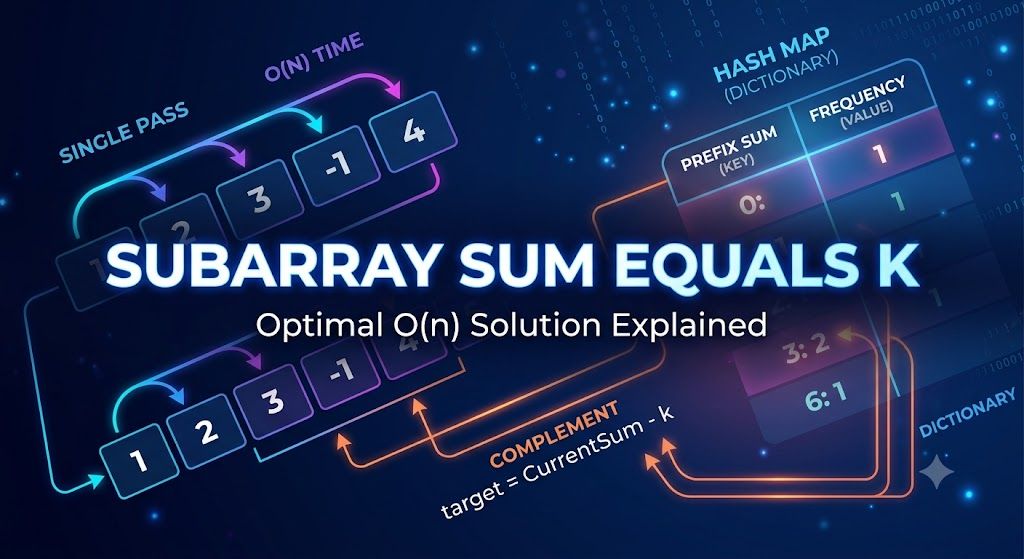
Problem Statement
Given an array of integers nums and an integer k, return the total number of continuous subarrays whose sum equals k.
Example 1:
- Input:
nums = [1, 1, 1], k = 2 - Output:
2
Example 2:
- Input:
nums = [1, 2, 3], k = 3 - Output:
2
Constraints:
- 1≤nums.length≤2×10⁴
- −1000≤nums[i]≤1000
- −107≤k≤107
Brute Force:
Intuition
A subarray is defined by a start index and an end index. To check every possible subarray:
- We pick a starting point i for the subarray.
- We iterate through every possible ending point j starting from i to the end of the array.
- For every range [i,j], we calculate the sum of elements and check if that sum is equal to k.
Since we are checking all pairs (i,j), there are O(n2) possible subarrays.
Algorithm
- Initialize a counter
count = 0. - Use an outer loop with index i from 0 to n−1 (the start of the subarray).
- Inside, maintain a variable
current_sum = 0. - Use an inner loop with index j from i to n−1 (the end of the subarray).
- Add
nums[j] to current_sum. - If
current_sum == k, increment count. - Return
count after all loops finish.
def subarraySum(nums, k):
    count = 0
    n = len(nums)

    # Outer loop for start index
    for i in range(n):
        current_sum = 0
        # Inner loop for end index
        for j in range(i, n):
            current_sum += nums[j]

            # Check if condition is met
            if current_sum == k:
                count += 1

    return count
Dry Run
============================================================
DRY RUN: Subarray Sum Equals K (Brute Force)
Input: nums = [1, 2, 3], k = 3
============================================================

[Phase 1: Starting at index 0]
  i=0, j=0: Subarray [1]       | Sum = 1
  i=0, j=1: Subarray [1, 2]    | Sum = 3  >> MATCH FOUND!
  i=0, j=2: Subarray [1, 2, 3] | Sum = 6

[Phase 2: Starting at index 1]
  i=1, j=1: Subarray [2]       | Sum = 2
  i=1, j=2: Subarray [2, 3]    | Sum = 5

[Phase 3: Starting at index 2]
  i=2, j=2: Subarray [3]       | Sum = 3  >> MATCH FOUND!

============================================================
Total Count: 2
============================================================
Complexity Analysis
- Time Complexity: O(n2) because we have nested loops iterating through the array.
- Space Complexity: O(1) as we only use a few variables for counting and summing.
Optimal approach
Imagine you are walking along the array, keeping a running total called current_sum.
- The Goal: We want to find a subarray that sums to
k. Mathematically, this means:Sum(i to j)=PrefixSumj−PrefixSumi−1=k - The Rearrangement: If we move PrefixSumi−1 to the other side, we get:PrefixSumj−k=PrefixSumi−1
- The "Aha!" Moment: As we iterate through the array, at any point
j, we know our current total (PrefixSum_j). We just need to check: "Have I seen a previous prefix sum that equals current_sum - k?" * If the answer is Yes, it means the elements between that previous point and the current point must sum exactly to k.
The Hash Map Strategy
Instead of using a nested loop to re-calculate sums, we use a Hash Map (Dictionary) to store every PrefixSum we encounter and how many times we have seen it.
- Key: The
PrefixSum value. - Value: How many times this
PrefixSum has occurred so far.
To implement the optimal O(n) solution, we use a Hash Map (or dictionary) to keep track of the prefix sums encountered so far.
The Algorithm
- Initialize Variables:
count = 0: To keep track of the number of valid subarrays found.current_sum = 0: To store the running total of elements.prefix_sums = {0: 1}: A dictionary (hash map) initialized with {0: 1}. This handles cases where a subarray starting from index 0 equals k.
- Iterate Through the Array:
- For each element
num in the array:- Update
current_sum by adding num. - Check for Complement: Calculate
target = current_sum - k. - If
target exists in the prefix_sums dictionary, it means there is a subarray that sums to k. Add the frequency of target to count. - Update Map: Store or increment the
current_sum in the prefix_sums dictionary to make it available for future lookups.
- Return:
- After iterating through the entire array, return
count.
C++ code:
class Solution {
public:
int subarraySum(vector<int>& nums, int k) {
int count = 0;
int current_sum = 0;
unordered_map<int, int> prefix_sums;
prefix_sums[0] = 1;
for (int num : nums) {
current_sum += num;
if (prefix_sums.count(current_sum - k)) {
count += prefix_sums[current_sum - k];
}
prefix_sums[current_sum]++;
}
return count;
}
};
Dry Run:
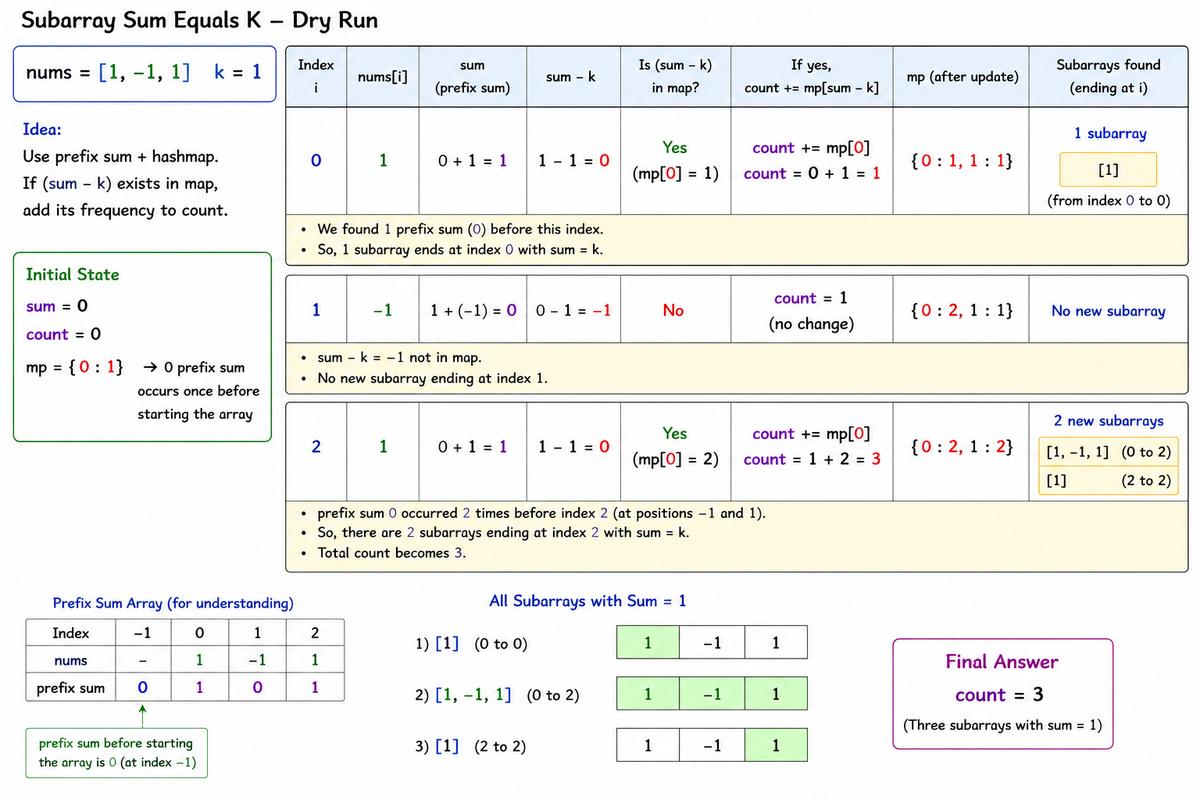
1. Time Complexity: O(n)
- Single Traversal: We iterate through the array of n elements exactly once.
- Constant Time Lookups: Inside the loop, we perform dictionary operations (
find or count) and updates (insert or increment). In C++, unordered_map provides an average O(1) time complexity for these operations. - Total Calculation: Since we perform a constant number of O(1) operations for each of the n elements, the overall time complexity is O(n)×O(1)=O(n).
2. Space Complexity: O(n)
- Hash Map Storage: In the worst-case scenario (e.g., an array where every prefix sum is unique), we will store a new entry in the
unordered_map for every element we process. - Total Calculation: This results in a space requirement that grows linearly with the input size, leading to O(n) space complexity.
problem :
Subarray Sum Equals K - LeetCode
video reference:
https://youtu.be/xvNwoz-ufXA?si=Y_PVG5Lv0CnQT-XV