Problem Statement
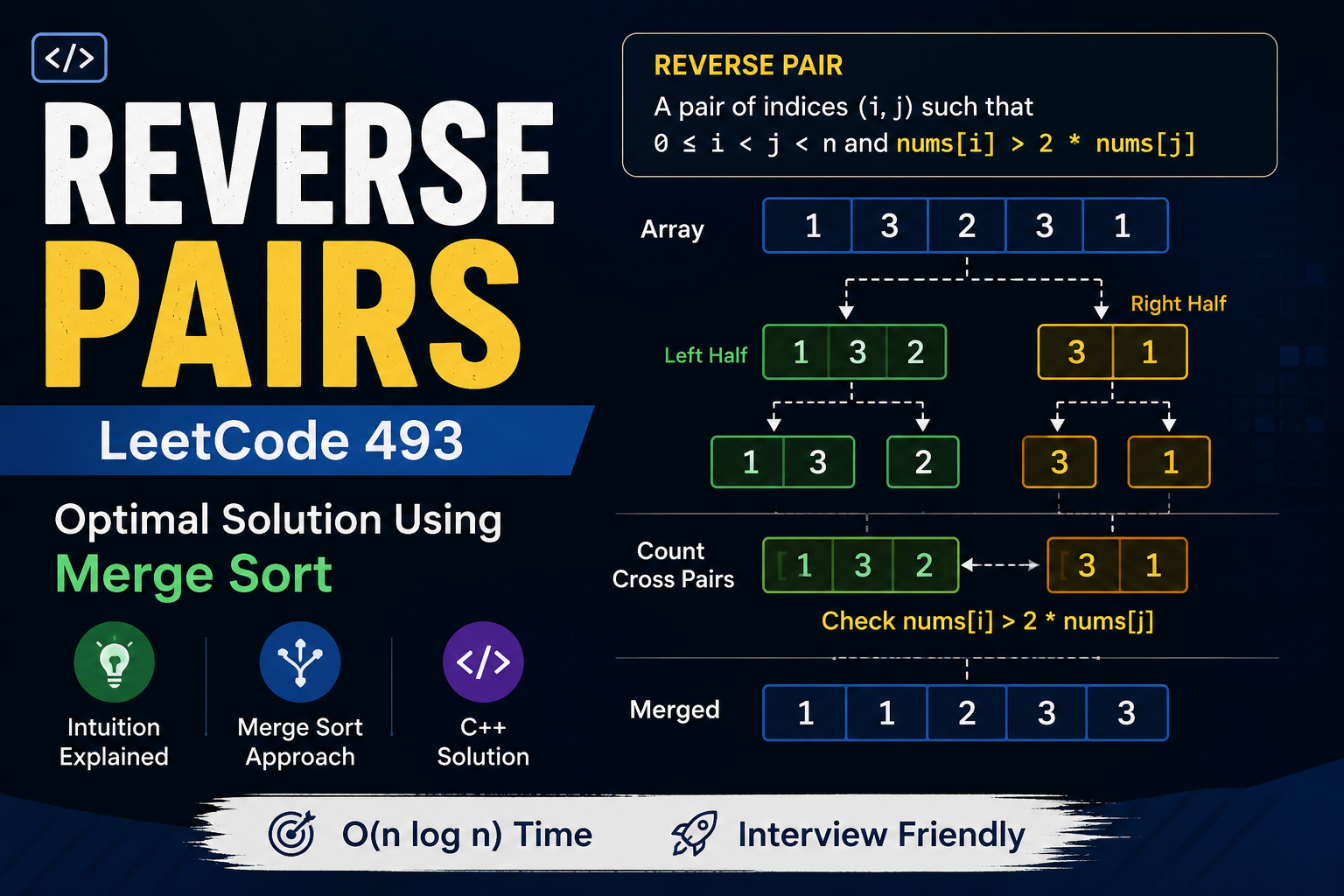
Given an integer array nums, return the number of reverse pairs in the array.
A reverse pair is a pair of indices (i, j) such that:
0 <= i < j < nums.lengthnums[i] > 2 * nums[j]
Your task is to count all such reverse pairs efficiently.
Example 1
Input
nums = [1,3,2,3,1]
Output
2
Explanation
The reverse pairs are:
(3,1) → 3 > 2 × 1
(3,1) → 3 > 2 × 1
Therefore, the total number of reverse pairs is 2.
Example 2
Input
nums = [2,4,3,5,1]
Output
3
Explanation
The reverse pairs are:
(4,1) → 4 > 2 × 1
(3,1) → 3 > 2 × 1
(5,1) → 5 > 2 × 1
Hence, the answer is 3.
Naive (Brute Force) Solution
The simplest approach is to check every possible pair (i, j) where i < j.
If:
nums[i] > 2 * nums[j]
then it is a reverse pair, so increment the count.
C++ Code
class Solution {
public:
    int reversePairs(vector<int>& nums) {
        int count = 0;
        int n = nums.size();

        for(int i = 0; i < n; i++) {
            for(int j = i + 1; j < n; j++) {
                if((long long)nums[i] > 2LL * nums[j]) {
                    count++;
                }
            }
        }

        return count;
    }
};
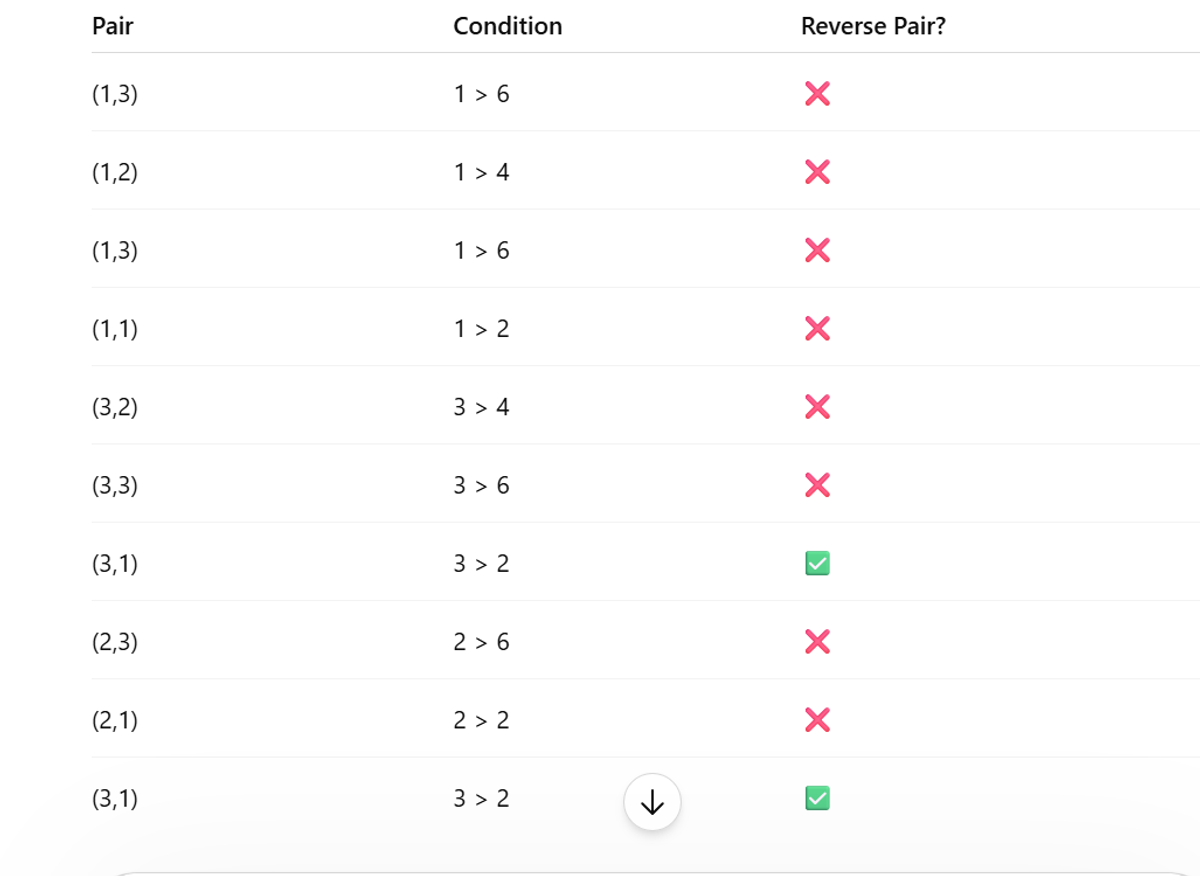
Dry Run
nums = [1,3,2,3,1]
Complexity Analysis
- Time Complexity:
O(n²) - Space Complexity:
O(1)
Why It Gets TLE
For:
n = 50,000
the number of comparisons is approximately:
n² = 50,000 × 50,000 = 2.5 billion
which is too slow.
That's why we use the Merge Sort based O(n log n) solution.
Optimal Approach (Merge Sort)
prerequisite:
merge sort
The brute-force solution checks every pair, resulting in O(n²) time.
To optimize, we use Merge Sort.
Key Observation
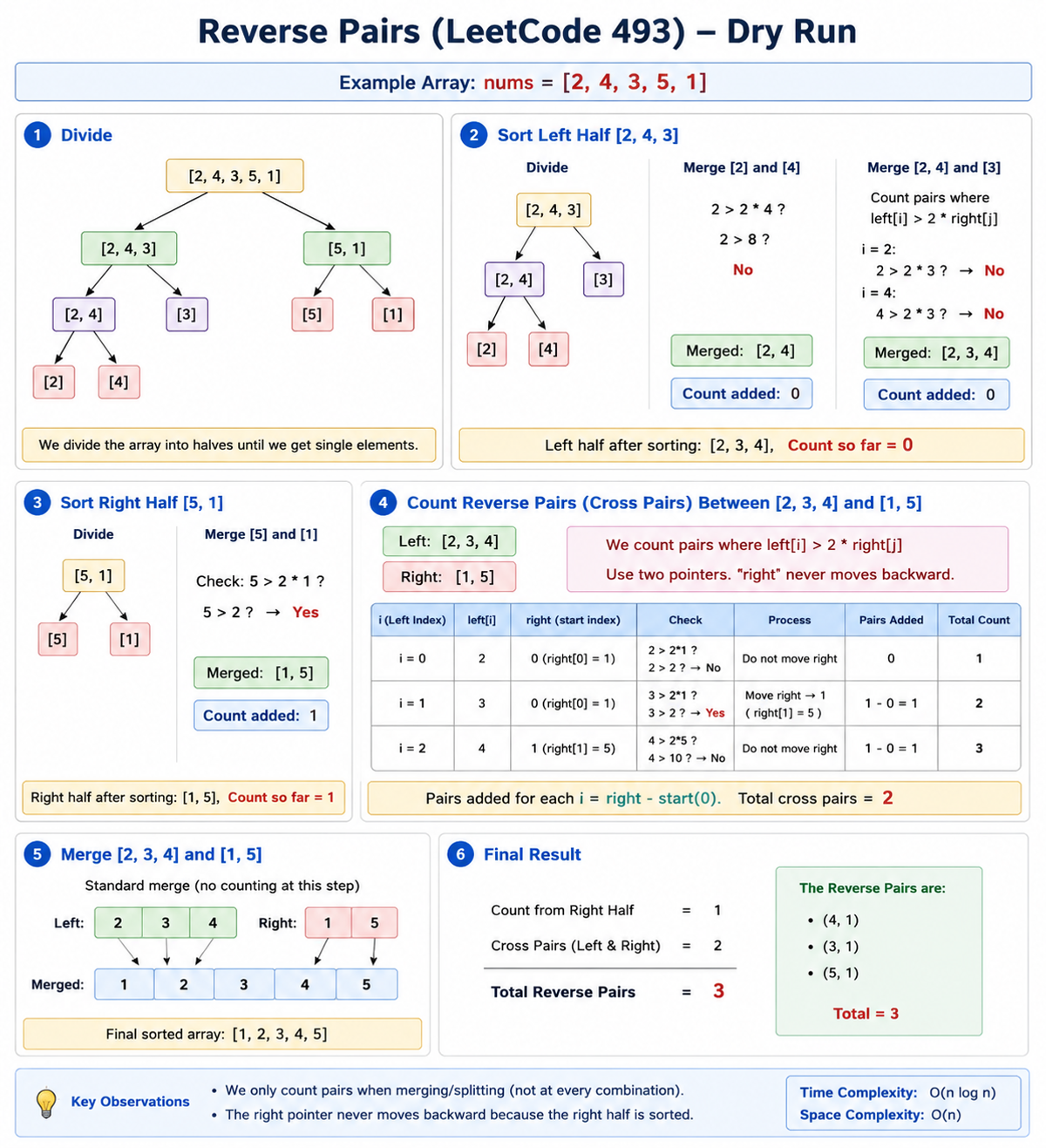
During Merge Sort, the left half and right half are already sorted.
Suppose:
Left = [1, 4, 5]
Right = [1, 2]
For each element in the left half, we want to count how many elements in the right half satisfy:
arr[i] > 2LL * arr[j]
Since the right half is sorted, once a j satisfies the condition, all previous valid j's are also counted. We can use a moving pointer and count efficiently.
Dry Run:
Algorithm
- Divide the array into two halves.
- Recursively count reverse pairs in the left half.
- Recursively count reverse pairs in the right half.
- Count reverse pairs across the two halves.
- Merge the two sorted halves.
class Solution {
public:
    int merge(vector<int>& arr, int low, int mid, int high) {
        vector<int> temp;
        int left = low;
        int right = mid + 1;

        while(left <= mid && right <= high) {
            if(arr[left] <= arr[right]) {
                temp.push_back(arr[left++]);
            } else {
                temp.push_back(arr[right++]);
            }
        }

        while(left <= mid) temp.push_back(arr[left++]);
        while(right <= high) temp.push_back(arr[right++]);

        for(int i = low; i <= high; i++) {
            arr[i] = temp[i - low];
        }

        return 0;
    }

    int countPairs(vector<int>& arr, int low, int mid, int high) {
        int right = mid + 1;
        int count = 0;

        for(int i = low; i <= mid; i++) {
            while(right <= high &&
                  arr[i] > 2LL * arr[right]) {
                right++;
            }

            count += (right - (mid + 1));
        }

        return count;
    }

    int mergeSort(vector<int>& arr, int low, int high) {
        if(low >= high) return 0;

        int mid = low + (high - low) / 2;

        int count = 0;

        count += mergeSort(arr, low, mid);
        count += mergeSort(arr, mid + 1, high);

        count += countPairs(arr, low, mid, high);

        merge(arr, low, mid, high);

        return count;
    }

    int reversePairs(vector<int>& nums) {
        return mergeSort(nums, 0, nums.size() - 1);
    }
};
Complexity
- Time Complexity:
O(n log n) - Space Complexity:
O(n)
problem link:
Reverse Pairs - LeetCode
video reference link:
Reverse Pairs | Hard Interview Question