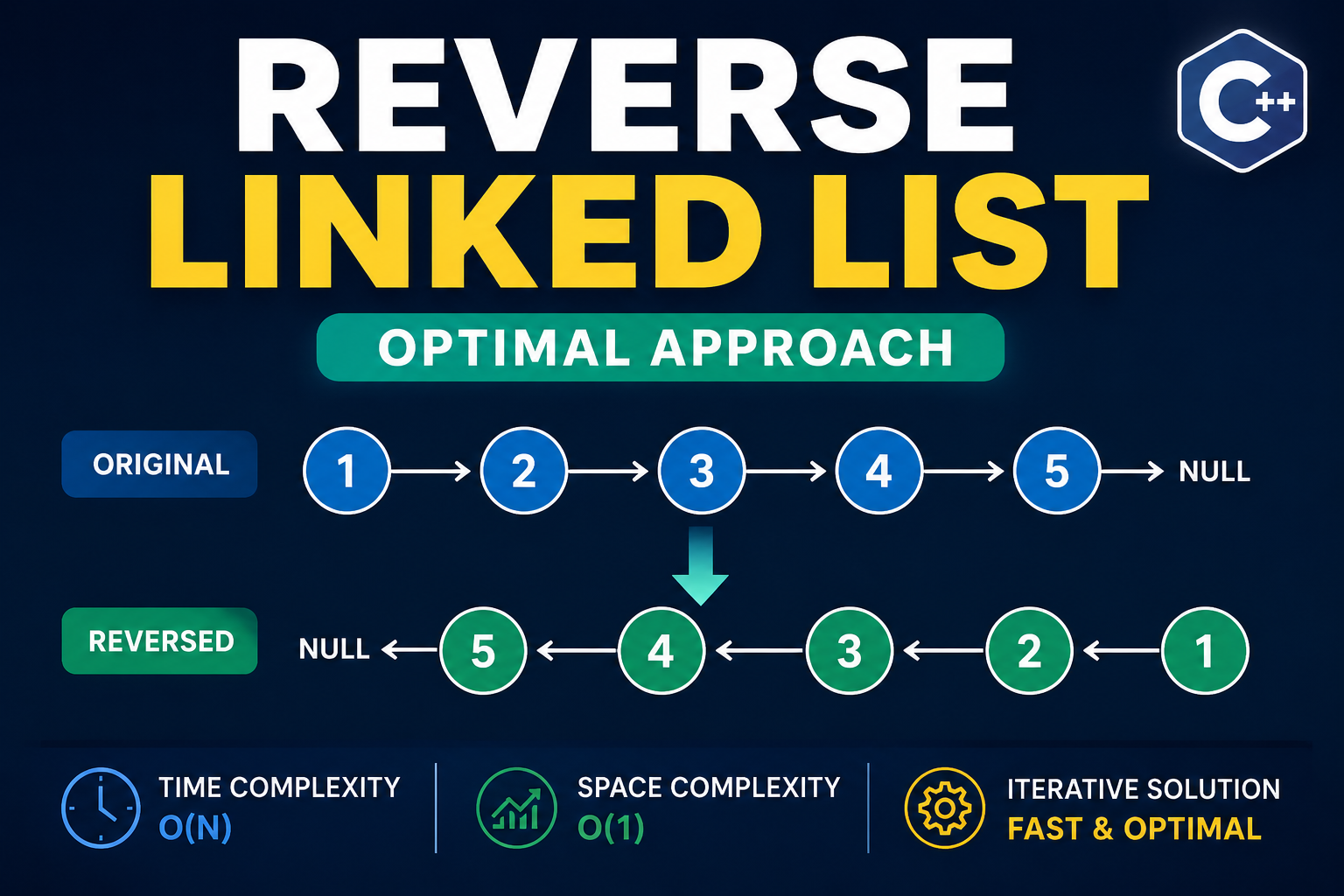
Reverse a Linked List (LeetCode 206)
Linked Lists are one of the most important data structures in Data Structures and Algorithms. A frequently asked interview question is reversing a singly linked list.
In this article, we'll understand the intuition, dry run, code implementation, and complexity analysis of the brute and optimal solution.
Brute Force
1. Intuition
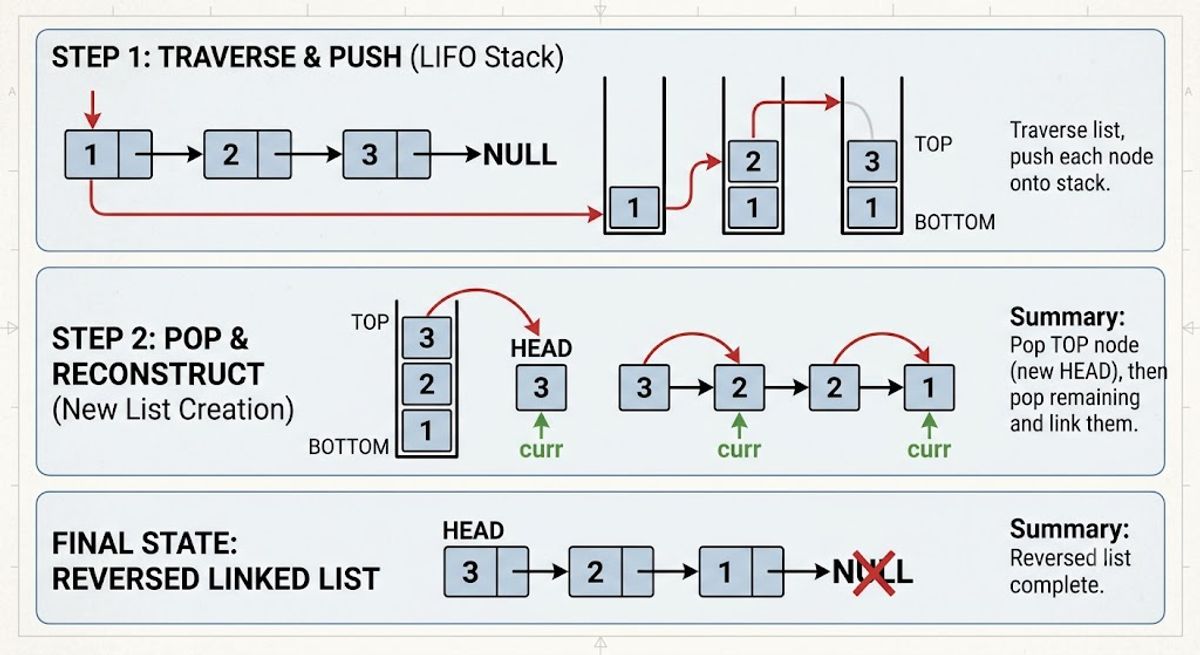
The brute force approach relies on the Last-In, First-Out (LIFO) property of a Stack.
Since a linked list is unidirectional (nodes point from current to next), we cannot easily go backward. However, if we store all the nodes in a stack, the last node we pushed onto the stack will be the first one we pop. By popping them in reverse order and re-linking them, we effectively reverse the list.
Algorithm
- Check if the list is empty or has only one node; return it if so.
- Initialize an empty stack of type
Node*. - Traverse the linked list and push every node into the stack.
- Pop the top node from the stack and set it as the new
head. - Maintain a
curr pointer to keep track of the node currently being processed in the new order. - While the stack is not empty:
- Pop the next node from the stack.
- Point
curr->next to this node. - Move
curr to this node.
- Set the last node's
next pointer to NULL to terminate the list. - Return the new
head.
#include <iostream>
#include <stack>
using namespace std;
class Solution {
public:
ListNode* reverseList(ListNode* head) {
if (!head || !head->next) return head;
stack<ListNode*> s;
ListNode* curr = head;
while (curr != nullptr) {
s.push(curr);
curr = curr->next;
}
ListNode* newHead = s.top();
s.pop();
curr = newHead;
while (!s.empty()) {
curr->next = s.top();
s.pop();
curr = curr->next;
}
curr->next = nullptr;
return newHead;
}
};
Complexity Analysis
- Time Complexity: O(N), where N is the number of nodes. We traverse the list once to push and once to pop.
- Space Complexity: O(N), because we store all N nodes in the stack.
Alternate Approach
1. Intuition
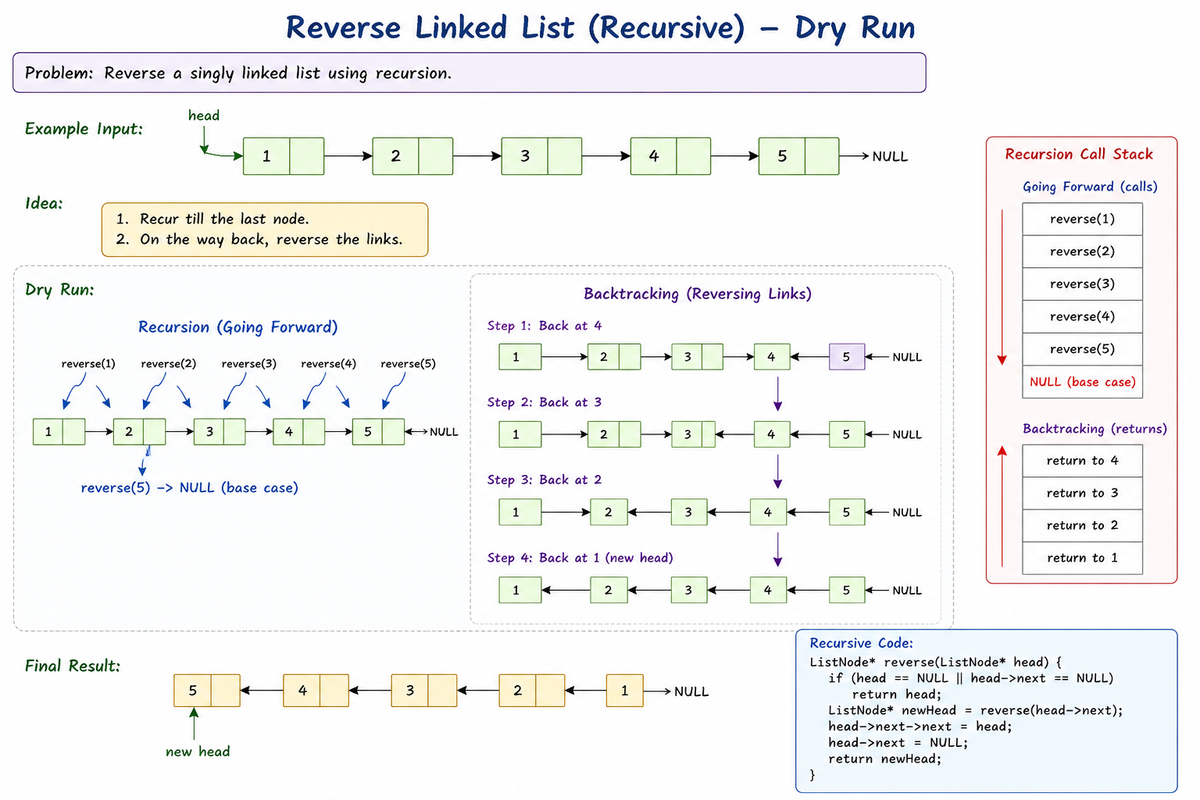
Think of recursion as "diving" to the end of the list first. Once you reach the last node, you stop and start returning back. As you return, you flip the next pointer of each node to point to the node that preceded it in the recursion
Dry Run:
Algorithm – Reverse a Linked List (Recursive Approach)
Idea:
- Keep moving recursively until you reach the last node.
- The last node becomes the new head.
- While returning (backtracking), reverse each link.
Steps
- If the list is empty or has only one node, return that node.
- Recursively reverse the remaining list starting from
head->next. - Make the next node point back to the current node:
- Break the old forward link:
- Return the new head obtained from recursion.
class Solution {
public:
ListNode* reverseList(ListNode* head) {
if (head == nullptr || head->next == nullptr) {
return head;
}
ListNode* newHead = reverseList(head->next);
head->next->next = head;
head->next = nullptr;
return newHead;
}
};
Explanation
=========================================================
REVERSE LINKED LIST (RECURSIVE) - COMPLETE EXPLANATION
=========================================================

Input:
1 -> 2 -> 3 -> NULL


---------------------------------------------------------
STEP 1: RECURSIVE CALLS GO TILL THE LAST NODE
---------------------------------------------------------

reverse(1)
    reverse(2)
        reverse(3)

Node 3 is the last node.

Base Case:

if(head == NULL || head->next == NULL)
    return head;

So:

reverse(3) returns 3

newHead = 3


---------------------------------------------------------
STEP 2: BACKTRACKING STARTS AT NODE 2
---------------------------------------------------------

Current List:

2 -> 3 -> NULL


Code Executed:

head->next->next = head;


Substitution:

2->next->next = 2

Since:

2->next = 3

It becomes:

3->next = 2


Now the structure looks like:

2 -----> 3
^        |
|________|


A cycle is formed.

To break the old link:

head->next = NULL;

i.e.

2->next = NULL


Final Structure:

3 -> 2 -> NULL


---------------------------------------------------------
STEP 3: BACKTRACKING CONTINUES AT NODE 1
---------------------------------------------------------

Current List:

1 -> 2 -> NULL


Code Executed:

head->next->next = head;


Substitution:

1->next->next = 1

Since:

1->next = 2

It becomes:

2->next = 1


Now:

1 -----> 2
^        |
|________|


Again a cycle is formed.

Break the old link:

head->next = NULL;

i.e.

1->next = NULL


Final Structure:

3 -> 2 -> 1 -> NULL


---------------------------------------------------------
WHY THESE TWO LINES ARE IMPORTANT?
---------------------------------------------------------

head->next->next = head;
head->next = NULL;


Line 1:
---------

head->next->next = head;

Example:

2 -> 3

becomes

2 <- 3

It reverses the direction.


Line 2:
---------

head->next = NULL;

Removes the old forward connection.

Without this line:

2 <-> 3

Cycle will be formed.


---------------------------------------------------------
VISUALIZATION
---------------------------------------------------------

GOING DOWN (Recursive Calls)

1 -> 2 -> 3 -> 4 -> 5


COMING UP (Backtracking)

5 <- 4
5 <- 4 <- 3
5 <- 4 <- 3 <- 2
5 <- 4 <- 3 <- 2 <- 1


Final Answer:

5 -> 4 -> 3 -> 2 -> 1 -> NULL


---------------------------------------------------------
FULL CODE
---------------------------------------------------------

class Solution {
public:
    ListNode* reverseList(ListNode* head) {

        if(head == NULL || head->next == NULL)
            return head;

        ListNode* newHead = reverseList(head->next);

        head->next->next = head;
        head->next = NULL;

        return newHead;
    }
};


---------------------------------------------------------
TIME & SPACE COMPLEXITY
---------------------------------------------------------

Time Complexity  : O(N)

Space Complexity : O(N)
                   (Recursion Stack)

=========================================================
Complexity Analysis:
TIME COMPLEXITY
Let N be the number of nodes.
For every node:
1. One recursive call is made.
2. During backtracking, only constant-time operations
are performed:
head->next->next = head;
head->next = NULL;
Each node is visited exactly once.
Therefore:
T(N) = T(N-1) + O(1)
Solving:
T(N) = O(N)
Time Complexity = O(N)
SPACE COMPLEXITY
No extra data structures are used.
However, recursion uses the call stack.
Example:
reverse(1)
reverse(2)
reverse(3)
reverse(4)
reverse(5)
There are N function calls stored in memory.
Stack Space = O(N)
Therefore:
Space Complexity = O(N)
WHY NOT O(1) SPACE?
Many students think:
"No extra array, stack, or vector is used,
so space should be O(1)."
Wrong.
Recursive calls themselves occupy memory.
For N nodes:
Call Stack Size = N
Hence:
Auxiliary Space = O(N)
FINAL ANSWER
Time Complexity : O(N)
Space Complexity : O(N)
(due to recursion call stack)
=========================================================
OPTIMAL APPROACH
Intuition
Suppose we have:
1 -> 2 -> 3 -> 4 -> 5 -> NULL
We want:
5 -> 4 -> 3 -> 2 -> 1 -> NULL
The problem is that when we reverse a link, we might lose access to the remaining nodes.
For example:
1 -> 2 -> 3 -> NULL
If we directly do:
1->next = NULL;
then we lose the connection to node 2 and node 3.
So before changing any link, we first save the next node.
That's why we use 3 pointers in this approach:
prev → previous nodecurr → current nodenext → next node (saved temporarily)
For every node:
- Save next node.
- Reverse current link.
- Move all pointers one step ahead.
Repeat until the list ends.
Algorithm
ALGORITHM: Reverse Linked List (Iterative)

1. INITIALIZE:
   prev = NULL
   curr = head

2. WHILE curr IS NOT NULL:
   a. Store next node:
      next = curr->next

   b. Reverse link:
      curr->next = prev

   c. Move pointers forward:
      prev = curr
      curr = next

3. RETURN prev (This is the new head)
DRY RUN
To perform a dry run of the iterative algorithm, let's take a sample list: 1 -> 2 -> 3 -> NULL.
Here is the step-by-step trace of how the pointers behave.
Initial State
Step-by-Step Execution
Iteration 1 (Processing node 1)
- Store next:
next = 2 - Reverse link:
1->next = NULL (1 now points to prev) - Move pointers:
prev = 1, curr = 2
- List status:
NULL <- 1 2 -> 3 -> NULL
Iteration 2 (Processing node 2)
- Store next:
next = 3 - Reverse link:
2->next = 1 (2 now points to prev) - Move pointers:
prev = 2, curr = 3
- List status:
NULL <- 1 <- 2 3 -> NULL
Iteration 3 (Processing node 3)
- Store next:
next = NULL - Reverse link:
3->next = 2 (3 now points to prev) - Move pointers:
prev = 3, curr = NULL
- List status:
NULL <- 1 <- 2 <- 3
Finalization
- Loop Condition:
curr is now NULL, so the loop terminates. - Return: We return
prev, which is currently pointing to Node 3. - Result:
3 -> 2 -> 1 -> NULL
class Solution {
public:
ListNode* reverseList(ListNode* head) {
ListNode* prev = nullptr;
ListNode* curr = head;
ListNode* next = nullptr;
while (curr != nullptr) {
next = curr->next;
curr->next = prev;
prev = curr;
curr = next;
}
return prev;
}
};
Complexity Analysis:
TIME COMPLEXITY
Let N be the number of nodes in the linked list.
The while loop runs once for each node.
For every iteration, only constant-time operations
are performed:
1. next = curr->next
2. curr->next = prev
3. prev = curr
4. curr = next
Each operation takes O(1) time.
Since there are N nodes:
Total Time = N × O(1)
Time Complexity = O(N)
SPACE COMPLEXITY
Only three extra pointers are used:
prev
curr
next
Regardless of the size of the linked list,
the number of extra variables remains constant.
No recursion stack.
No extra array/vector/stack.
Space Complexity = O(1)
problem:
Reverse Linked List - LeetCode
Video reference:
L9. Reverse a LinkedList | Iterative and Recursive