
My projects
Scam Guard: Building an AI-Powered Digital Trust Platform with Google AI
CH
Chakradhar·
scam gurad
CH
Chakradhar
Author at SyntaxFlow
Author at SyntaxFlow
Scams are becoming increasingly sophisticated. Fraudsters no longer rely only on obvious messages or suspicious links. Social-engineering techniques, impersonation, convincing phone conversations, and increasingly realistic digital content can make fraudulent interactions difficult to identify.
At the same time, fraud is not limited to the digital world. Counterfeit currency continues to create risks for individuals and businesses at the point of transaction.
This made me think about a simple question:
What if AI could help people identify fraud before they become victims, while also helping them understand the larger patterns behind these incidents?
That question led me to build Scam Guard, an AI-powered digital trust and public safety platform that combines scam detection, counterfeit currency analysis, fraud-network intelligence, and geospatial awareness.
The goal of Scam Guard is not simply to tell someone whether something is a scam.
The larger goal is to provide actionable intelligence.
A suspicious interaction can be analyzed at the individual level, related incidents can be connected to identify broader fraud patterns, and geographic information can help communities understand where scam activity is concentrated.
The platform brings these capabilities together:
This creates a pipeline that moves from detection to understanding to prevention.
One of the core capabilities of Scam Guard is voice-based scam analysis.
A suspicious conversation can contain important signals that are difficult to identify through simple keyword matching. Fraudsters may create urgency, impersonate authorities, threaten victims, request financial information, or manipulate users into transferring money.
To make these conversations analyzable, Scam Guard first converts speech into text using Google's speech technology.
The resulting transcript is then passed to Gemini, which analyzes the content and identifies potential indicators of fraudulent behavior.
The objective is not just to return a binary result such as "scam" or "not a scam." The system attempts to provide understandable reasoning so that users can see what makes an interaction suspicious.
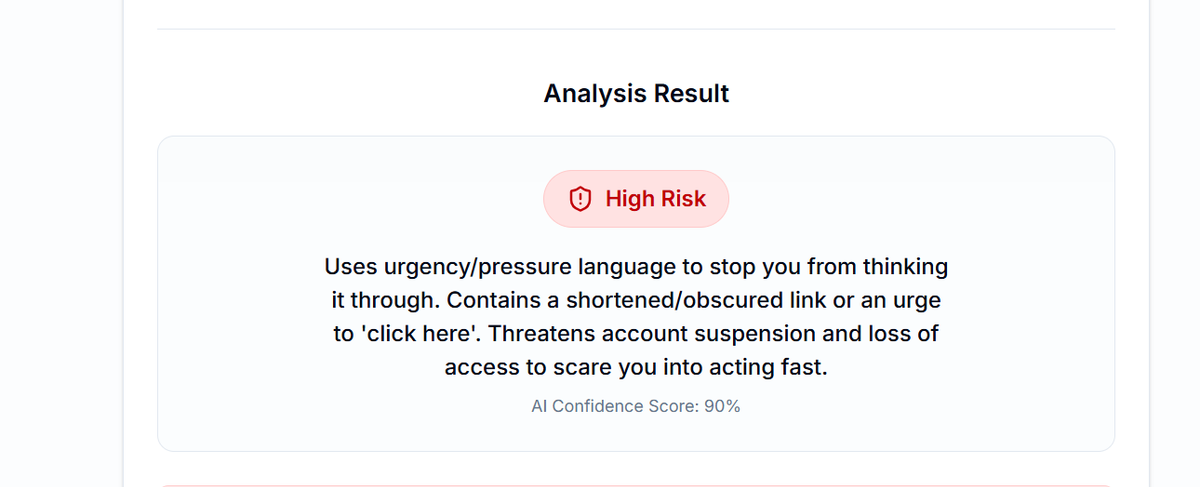
Once the speech has been converted into text, Gemini becomes the reasoning layer of the application.
Instead of relying entirely on predefined rules, the system can analyze the context of the conversation and look for patterns such as:
The result is presented in a way that is intended to be understandable to a non-technical user.
This was one of the most interesting parts of building Scam Guard because it showed me how Generative AI can be used not only to generate content, but also to interpret complex, unstructured information and turn it into useful guidance.
Digital fraud is only one side of the problem.
Scam Guard also includes an AI-assisted counterfeit currency detection capability.
A user can provide an image of a currency note, and the application sends the image to Gemini 3.5 Flash for visual analysis.
The model examines the available visual information and provides an assessment of characteristics that may indicate that the note is potentially counterfeit.
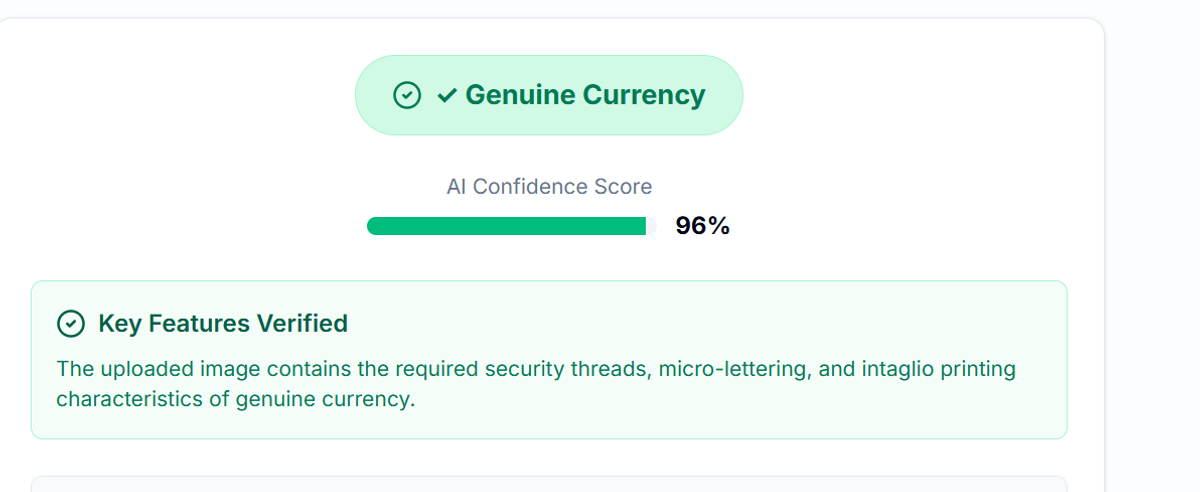
This feature extends Scam Guard beyond purely digital interactions and demonstrates how multimodal AI can be applied to physical-world problems as well.
The goal is to make the technology useful at the point where a person actually encounters a potential risk.
Detecting individual scams is useful, but organized fraud rarely consists of completely isolated incidents.
Multiple reports can sometimes be connected through common entities, infrastructure, communication patterns, or other relationships.
This led me to build a fraud-network graph within Scam Guard.
Instead of viewing every incident independently, the graph provides a way to visualize relationships between relevant entities and reported scam activity.
This changes the question from:
"Is this individual interaction suspicious?"
to:
"Is this incident part of a larger pattern?"
That shift is important for moving from individual detection toward broader fraud intelligence.
Another major part of Scam Guard is its geospatial intelligence layer.
Knowing that scams are occurring is useful. Knowing where reported scam activity is concentrated can provide additional context.
Scam Guard visualizes scam activity geographically so that citizens can understand patterns within their surrounding areas.
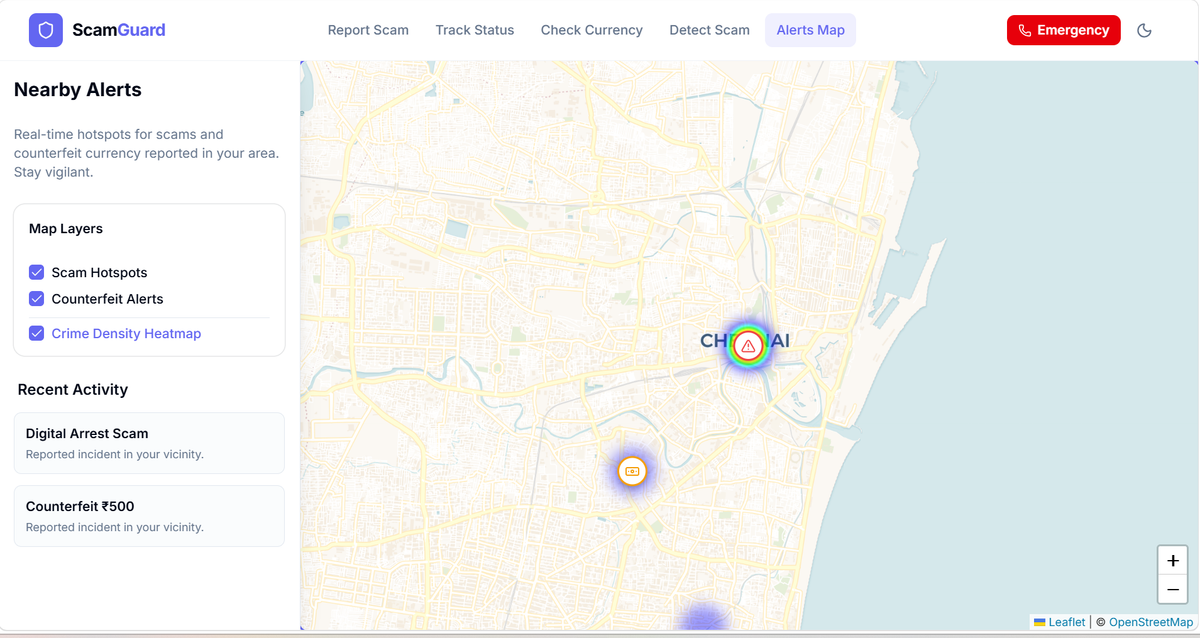
The intention is not to label an entire area as "unsafe," but to provide geographic context that can help people remain more alert to potential fraud patterns.
This also creates possibilities for future public-safety applications where aggregated intelligence could support resource allocation, awareness campaigns, and coordinated responses.
The different capabilities of Scam Guard are designed to complement each other.
A simplified view of the system is:
Voice / Image / Report
↓
Google AI Analysis
↓
Individual Risk Assessment
↓
Fraud Network Intelligence
↓
Geospatial Intelligence
↓
Citizen Awareness
The idea is to move from simply detecting an incident to understanding the larger context surrounding it.

Google AI technologies form an important part of the platform.
Used to convert voice input into text so that suspicious conversations can be analyzed.
Used as the reasoning and analysis layer for understanding suspicious conversations and scam-related content.
Used for multimodal analysis of currency-note images as part of the counterfeit detection capability.
The combination of speech processing, multimodal AI, application logic, graph intelligence, and geospatial visualization allowed me to build something that goes beyond a conventional chatbot.
Fraud affects people regardless of their technical background.
A student receiving a fraudulent job offer, a family member receiving a suspicious call, or a shopkeeper accepting a counterfeit note may not know what signals to look for.
I wanted Scam Guard to approach the problem from the user's perspective.
Instead of expecting everyone to become a cybersecurity expert, the system can provide AI-assisted intelligence that helps users understand:
What happened?
Why might it be suspicious?
Is there a broader pattern?
Where is similar activity occurring?
The goal is to make complex AI analysis more accessible to ordinary people.
Building Scam Guard taught me that developing an AI application is about much more than connecting an application to an AI model.
I had to think about how different forms of information could work together:
I also learned that an AI system designed for public safety needs to be approached carefully. False positives can unnecessarily alarm users, while false negatives can cause people to ignore genuine threats.
That makes accuracy, transparency, and responsible presentation of AI results just as important as the underlying model.
Scam Guard is still evolving.
Some of the areas I want to explore next include:
The long-term vision is to develop Scam Guard into a broader AI-powered Digital Public Safety Intelligence platform that can connect citizens, financial institutions, and eventually public-safety organizations.
Traditional fraud response often begins after a victim has already suffered a loss.
Scam Guard explores a different model:
Detect → Understand → Connect → Locate → Alert → Prevent
The objective is to bring intelligence closer to the point of contact.
Whether that contact is a suspicious phone conversation, a message, a financial transaction, or a physical currency note, AI can potentially help people recognize risk earlier.
For me, being a builder is not simply about using the newest technology.
It is about finding a problem that affects real people and asking:
Can technology make this problem easier, safer, or more understandable?
With Scam Guard, I am exploring how Google's AI technologies can help build a digital trust layer for everyday users—one that helps people detect threats earlier, understand why something is suspicious, recognize broader fraud patterns, and make safer decisions.
AI should not only make technology smarter.
It should help make people safer.
Google AI · Gemini · Gemini 3.5 Flash · Google Speech Technology · Graph Intelligence · Geospatial Intelligence