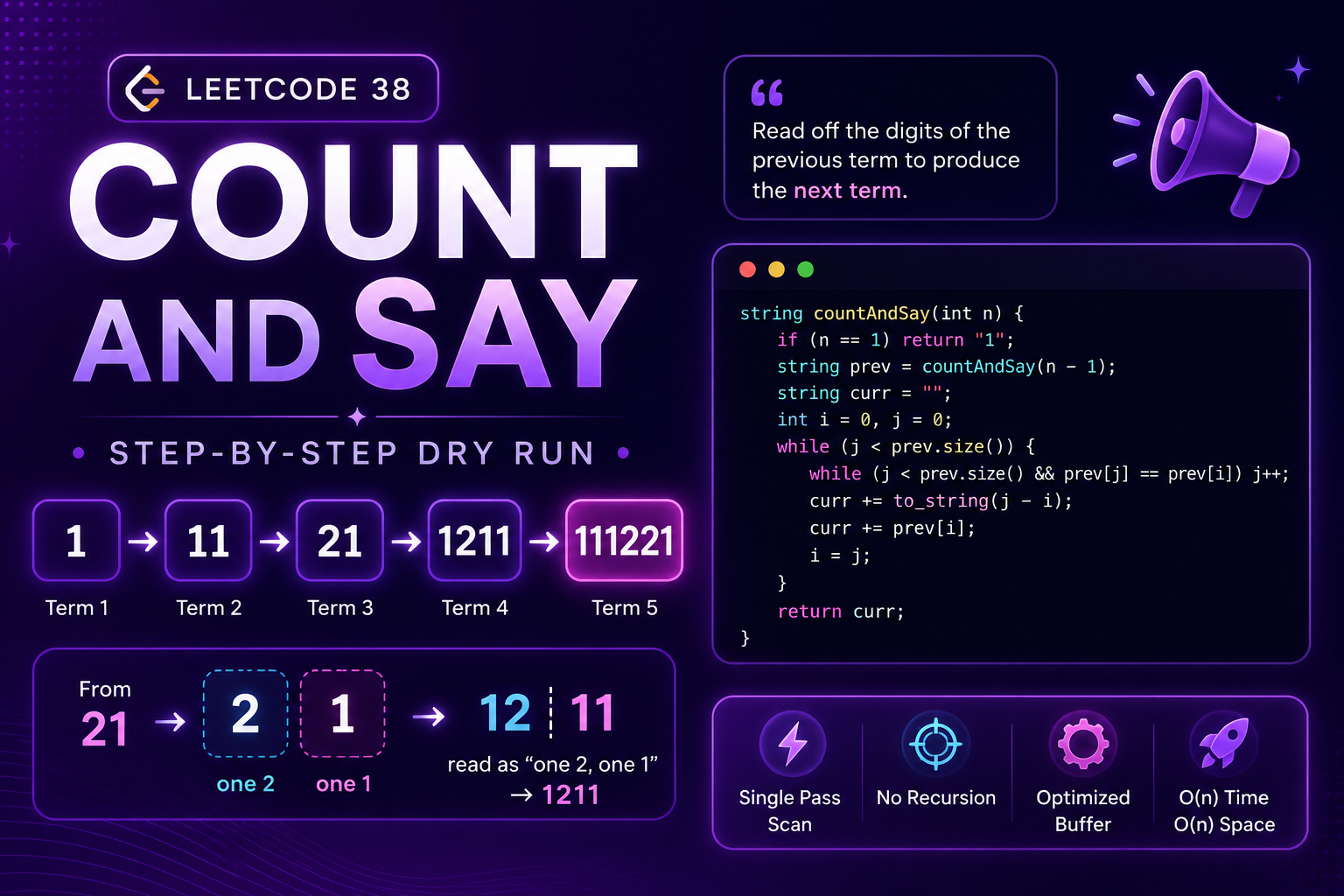
Count and Say: Brute Force to Optimal
LeetCode 38, solved three ways — recursive, iterative, and an optimized iterative version — with intuition, C++ code, an animated dry run for each approach, and complexity analysis you can explain out loud.
⏱ 8 min read🧩 Strings · Recursion · Simulation🎯 Difficulty: MediumOn this page
- Problem statement
- Approach 1 — Brute force (recursive)
- Approach 2 — Better (iterative bottom-up)
- Approach 3 — Optimal (iterative + efficient buffer)
- Complexity comparison
- Interview notes
- FAQ
Problem Statement
Given a positive integer n, return the nth term of the count-and-say sequence.
countAndSay(1) = "1", and every later term is the run-length encoding of the previous term — replace each maximal run of identical digits with "count followed by digit".
Example: for n = 4:
countAndSay(1) = "1"
countAndSay(2) = RLE of "1"    = "11"
countAndSay(3) = RLE of "11"   = "21"
countAndSay(4) = RLE of "21"   = "1211"
To keep every approach grounded in the same example, we'll trace how each one produces "1211" from "21" — once through a recursive call stack, once through a plain iterative scan, and once through an optimized single-pass buffer.
Approach 1 · Brute Force
Recursive Definition, Applied Literally
Intuition
The problem statement itself is a recurrence: countAndSay(n) depends on countAndSay(n-1). The most literal way to solve it is to translate that definition directly into a recursive function — call for the previous term, then run-length-encode whatever comes back.
It's the first working solution most people write, but two things make it the "brute" version here: it pays for a recursive call stack it doesn't need, and if you build the encoded result with plain string concatenation (result = result + ...), each concatenation silently creates a brand-new string object instead of extending one in place.
Algorithm
- Base case: if
n == 1, return "1". - Otherwise, recursively call
countAndSay(n - 1) to get the previous term. - Scan the previous term left to right, grouping consecutive identical digits.
- For each group, append
count followed by the digit to the result by reassigning a new string (result = result + ...). - Return the assembled result.
C++ Code
string countAndSay(int n) {
if (n == 1) return "1";
string prev = countAndSay(n - 1);
string result = "";
int i = 0;
while (i < (int)prev.size()) {
char ch = prev[i];
int count = 0;
while (i < (int)prev.size() && prev[i] == ch) {
count++;
i++;
}
result = result + to_string(count) + string(1, ch);
}
return result;
}
Dry Run
Complexity Analysis
| Metric |
Value |
Why |
| Time |
O(n · L²) |
n recursive levels, and naive + concatenation copies the whole string of length L on every group |
| Space |
O(n) stack + O(L) per level |
recursion depth of n, plus temporary strings created at each level |
| Practical issue |
Call stack overhead |
unnecessary function-call cost for a problem that is naturally sequential, not tree-like |
Approach 2 · Better
Build It Bottom-Up, Iteratively
Intuition
Since countAndSay(n) only ever needs the term right before it, there's no reason to recurse at all. Start from "1" and walk forward, run-length-encoding each term to produce the next one, stopping once you reach term n. This directly answers the problem's own follow-up: "could you solve it iteratively?"
Algorithm
- Start with
current = "1". - Loop
level from 2 to n. - Scan
current left to right with two pointers, grouping consecutive identical digits and their counts. - Append
count then the digit to a fresh string next using += (in-place append, not full reconstruction). - Set
current = next and continue; after the loop, current is the answer.
C++ Code
string countAndSay(int n) {
string current = "1";
for (int level = 2; level <= n; level++) {
string next = "";
int i = 0;
while (i < (int)current.size()) {
char ch = current[i];
int count = 0;
while (i < (int)current.size() && current[i] == ch) {
count++;
i++;
}
next += to_string(count);
next += ch;
}
current = next;
}
return current;
}
Dry Run
Complexity Analysis
| Metric |
Value |
Why |
| Time |
O(n · L) |
One linear scan per level; += appends are amortized O(1), no quadratic rebuild |
| Space |
O(L) |
Only the current and next strings are kept; no recursion stack |
| Improvement |
No call-stack overhead |
Matches the problem's own hint to solve it iteratively |
Approach 3 · Optimal
Iterative + a Single Efficient Buffer
Intuition
The iterative version is already solid, but two small inefficiencies remain: to_string(count) allocates a temporary string just to hold one digit, and rebuilding next from an empty string on every level can force multiple reallocations as it grows. Both are fixable with a fact specific to this sequence: a run of the same digit never has length greater than 3 (a known property of the look-and-say sequence), so the count is always a single digit — you can append it as a character directly, no to_string needed.
Algorithm
- Start with
current = "1". reserve() capacity for next up front to avoid repeated buffer growth.- Scan
current with two pointers exactly as before, but append the run count as '0' + count (a single character) instead of calling to_string. - Move
next into current with std::move to avoid an extra copy. - Repeat until level
n, then return current.
C++ Code
string countAndSay(int n) {
string current = "1";
for (int level = 2; level <= n; level++) {
string next;
next.reserve(current.size() * 2);
int i = 0;
int sz = (int)current.size();
while (i < sz) {
char ch = current[i];
int count = 0;
while (i < sz && current[i] == ch) {
count++;
i++;
}
next += char('0' + count);
next += ch;
}
current = move(next);
}
return current;
}
Dry Run
Complexity Analysis
| Metric |
Value |
Why |
| Time |
O(n · L) |
Same asymptotic scan, but fewer allocations per level in practice |
| Space |
O(L) |
One reserved buffer per level, moved instead of copied |
| Why optimal |
Lower constant factor |
No to_string calls, no repeated reallocation, no recursion stack |
Interview Notes
How to talk through it
- Write the recursive version first if it comes naturally — it mirrors the problem statement exactly — but immediately flag that it's not needed since each term only depends on the one directly before it.
- Pivot to the iterative version proactively; the problem's own follow-up asks for it, so bringing it up before being asked shows you read the prompt closely.
- If asked to optimize further, mention the "no run longer than 3" property of the look-and-say sequence — it's a nice piece of problem-specific insight that most candidates miss, and it justifies skipping
to_string().
Common follow-ups
- "Could you solve it iteratively?" → this is the official follow-up; walk through the bottom-up version directly.
- "What if n were very large, like 10⁵?" → discuss that the string length grows by roughly Conway's constant (~1.303x) per term, so even moderate n produces enormous strings — worth mentioning as a real scaling limit.
- "Can you avoid storing every previous term?" → you only ever need the immediately previous term, so a single rolling
current string (as shown above) is already optimal on memory.
Edge cases to mention
n = 1 → return "1" directly, no scanning needed.- A single run spanning the entire string (e.g.
"111") → the two-pointer scan should still terminate cleanly at the string's end. - Off-by-one errors in the inner while-loop bound (
i < size) are the most common bug — test with a term that ends mid-run.
Related problems
- String Compression (LeetCode 443)
- Run-Length Encoding / Decoding
- Look-and-Say sequence variants
- Two-pointer grouping problems in general
Frequently Asked Questions
What is the Count and Say sequence?
It's a sequence where each term describes the previous term using run-length encoding, starting from the base term "1". Reading a term out loud — "one 1", "two 1s", "one 2 one 1" — literally produces the next term.
Which approach should I lead with in an interview?
Write the iterative bottom-up version as your primary solution since it directly answers the stated follow-up question, then mention the recursive version only to show you understand the recurrence, and bring up the buffer/allocation optimizations if asked to go further.
What is the time complexity of Count and Say?
Producing all n terms takes time proportional to n times the length of the longest term, since each term requires exactly one linear scan of the term before it.
Can a digit repeat more than 3 times in a row?
No — this is a known property of the look-and-say sequence. Because of it, a run's count is always a single digit, which is what makes it safe to append the count as one character instead of using a general integer-to-string conversion.
video link:
code link